Among the Trees – Where we like to be!

Well what a year 2020 is turning out to be!

After the Spring lockdown and then being forced to move our fortnightly meetings to evening picnics in Chalkwell Park, we decided to get adventurous!

A trip to a gallery in London!!!

I led the way here by taking a reconnaissance visit to Whitechapel Art Gallery in July, risking public transport and spending several hours masked up! And so I was able to say, it was great. The train was quiet and I had walked from Fenchurch St to the gallery, which was very Covid-safe and empty. This is the best time to see art – there are no crowds!

We decided that Among the Trees at the Hayward Gallery would be a very interesting and varied exhibition with something for everyone.

After booking our time slot with the gallery, our travel plans were expertly co-ordinated by Juliet, who arranged which train and bus we would take. If the weather was fine, we planned to take a stroll along the South Bank.

Of course this is England in August and on the day of our trip, it was throwing it down, umbrellas and anoraks at the ready!

We safely negotiated the very empty C2C train to Fenchurch St, caught a bus from Tower Hill to Aldwych and walked over Waterloo bridge towards the South Bank Centre. This was also very quiet and we grabbed a lovely lunch at a restaurant with outside seating under large umbrellas.

So to the exhibition…Prepare to enter a forest of Art!
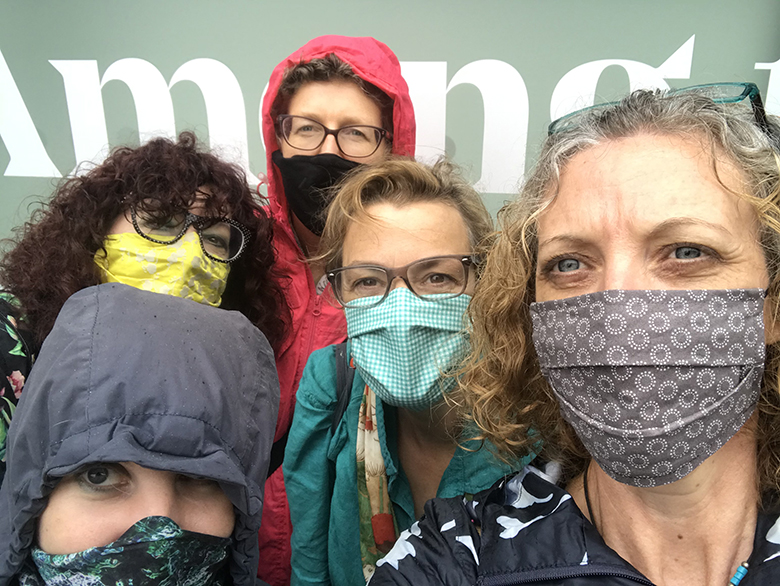
SEVEN, all masked up and ready to go!

I’ve had a thing about trees for years and so it was fantastic that a whole exhibition should be devoted to artists’ interactions and responses to trees.

Among the Trees gathers together works by more than 30 artists who reconfigure traditional genres and develop new ways of representing trees in order to shift our conventional perceptions and understanding.

A varied display of installation, video, photography, painting and sculpture had us marvelling one moment then questioning and wondering how this was made! Sometimes a piece of art was even quite distressing (I’m thinking of Robert Smithson’s upside down trees here!)

Here’s a small selection of work that we loved!
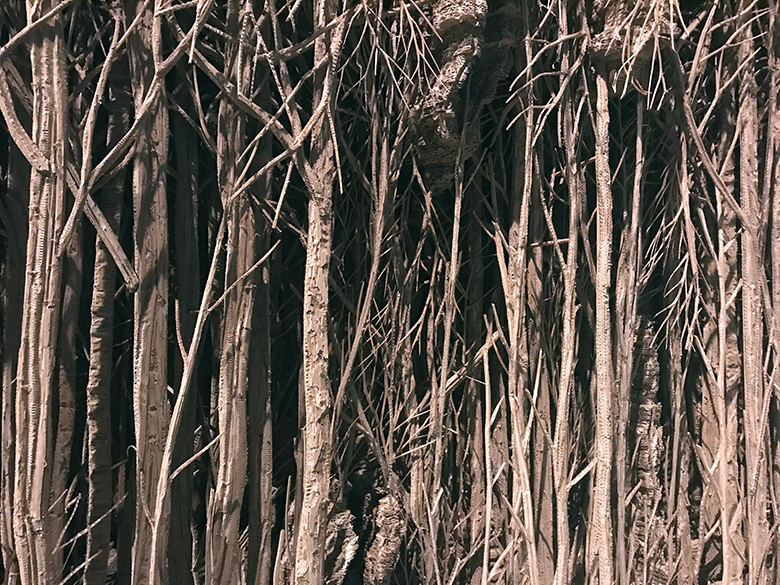
Eve Jospin: Forest, 2013
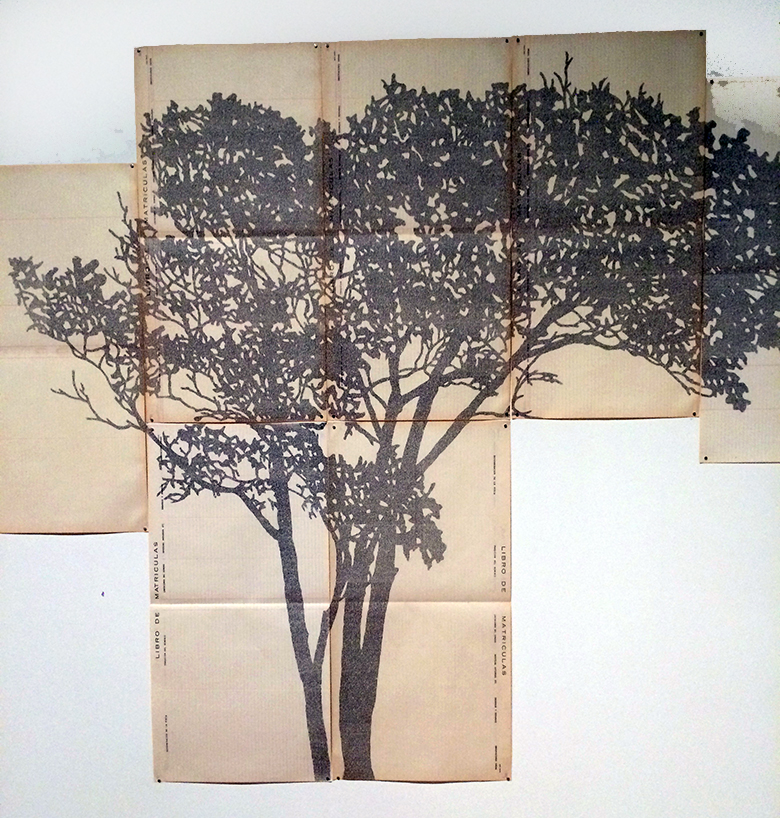
Johanna Calle: Perimetros (Nogal Andino), 2012
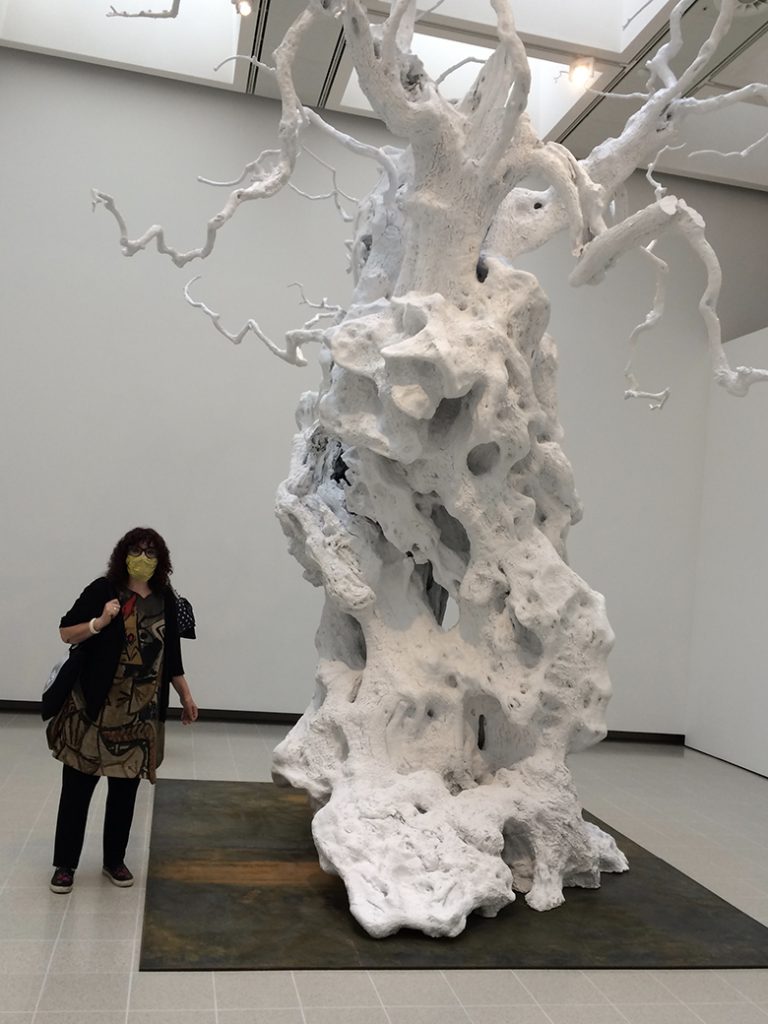
Kim getting up close to Ugo Rondinone: Wind Moon, 2011
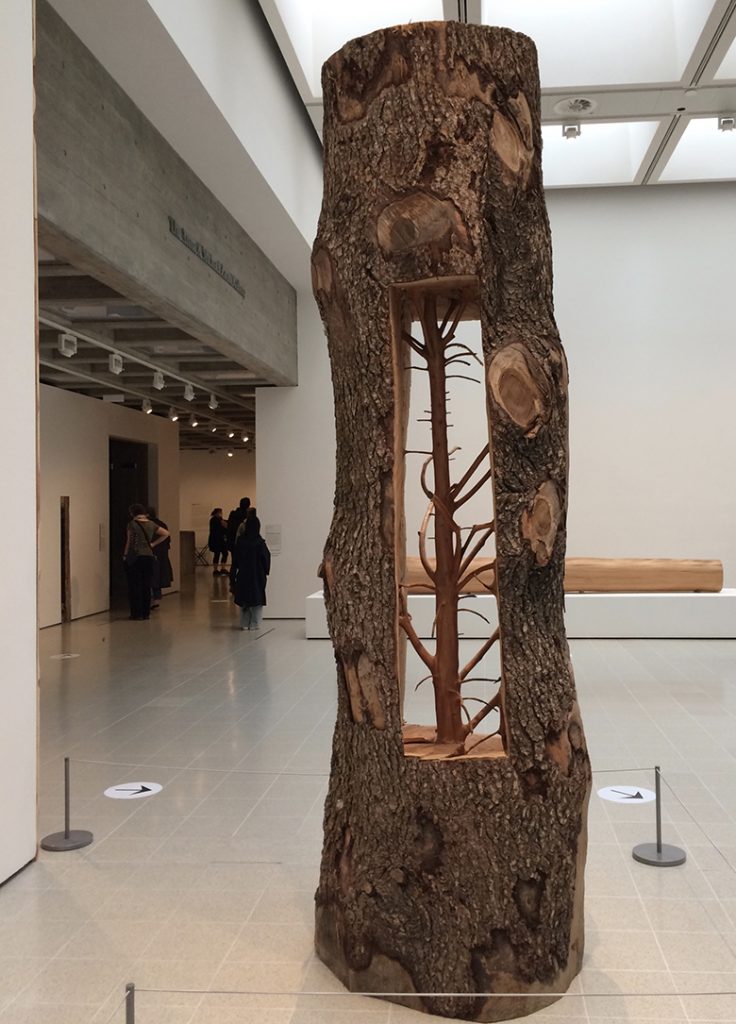
Giuseppe Penone: Albero Porta – Cedro, 2021

Humanity is finally waking up to the importance of trees, that they might be sentient beings, which can feel and communicate with one another, that they are of vital importance to our existence on this planet and that they exist on a much slower time than we do!  So next time you go for a walk in the woods, breathe in that air and marvel at these giants and how amazing they are!

Further reading

For those who want to learn more about trees here’s my recommendations:

  • Among the Trees Exhibition catalogue – Hayward Gallery Publishing
  • The Hidden Life of Trees by Peter Wohlleben
  • Shinrin-Yoku: the Art and Science of Forest Bathing by Dr Qing Li
  • Wildwood, a journey through trees by Roger Deakin

Here is a list of the participating artists:

Robert Adams, Eija-Liisa Ahtila, Yto Barrada, Johanna Calle, Gillian Carnegie, Tacita Dean, Peter Doig, Jimmie Durham, Kirsten Everberg, Simryn Gill, Rodney Graham, Shi Guowei, Hugh Hayden, Eva Jospin, Kazuo Kadonaga, William Kentridge, Toba Khedoori, Luisa Lambri, Myoung Ho Lee, Zoe Leonard, Robert Longo, Sally Mann, Steve McQueen, Jean-Luc Mylayne, Mariele Neudecker, Virginia Overton, Roxy Paine, Giuseppe Penone, Abel Rodríguez, Ugo Rondinone, George Shaw, Robert Smithson, Jennifer Steinkamp, Thomas Struth, Rachel Sussman, Pascale Marthine Tayou, Jeff Wall.
Journaling fun – back to our roots!

The Water Replies

SEVEN are really excited to be involved in Metal’s public participation project for this year’s Estuary Festival 2020. It’s right up our street, a journaling project!

Metal and Cement Fields are asking members of the public living and working on the Thames Estuary in South Essex and North Kent, to create a journal responding to ‘The Water Replies’ and providing free workshops in journaling and poetry writing.

We attended the first journaling workshop led by artist Heidi Wigmore, our mentor and champion and we’re delighted that we got a special mention on the night!

Chalkwell Hall was buzzing with activity, groups of people gathered around tables ready to create!

Loved the first prompt, the opening page of Joseph Conrad’s Heart of Darkness ready for us to alter. There are no rules here, we were given these ideas and asked to think about the flow of the water:

  • Highlight words, circle words, cross out text
  • Make a new thread or sentence
  • Stream of consciousness, see what words pop out at you!
  • Cover the rest of the page with paint, collage, marker pens whatever you like

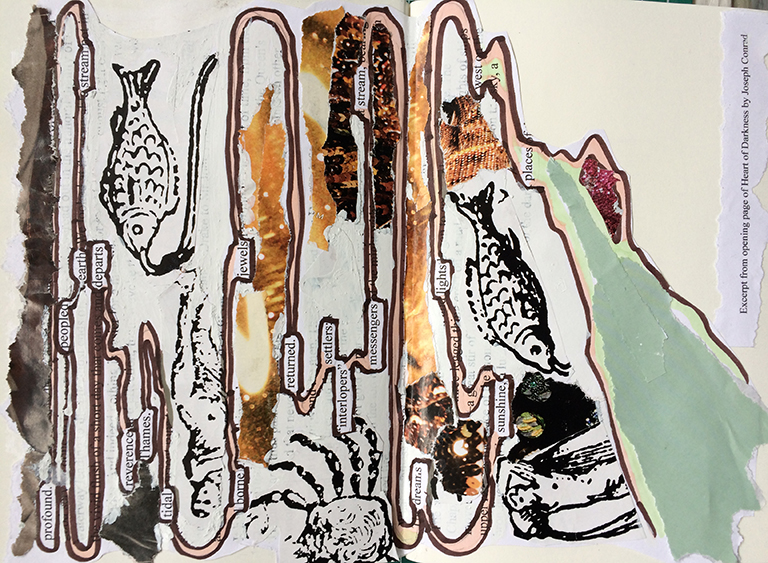
Here’s my page added to the journal, and we’re off!

Amanda’s first page exploring Joseph Conrad’s Heart of Darkness

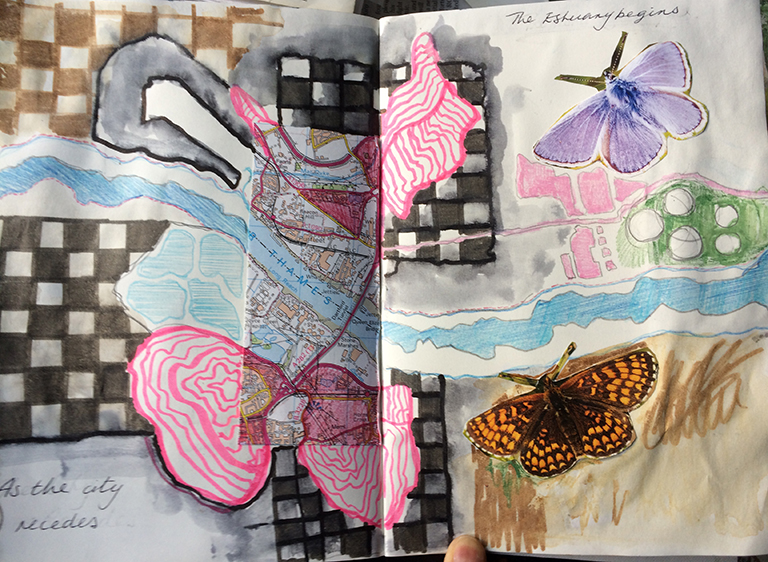
We were each then given a small section of map that included sections of the Thames to stick into a page of the journal – look at the lines and marks on the map:

  • Add to them
  • Extend the lines
  • Extend lines of the river across other pages or the whole journal
Amanda’s page – extending lines on a map

All in all a great start to this project. We will fill our journals and return them to Metal for display in a library/reading room.  It will be exciting to see everyone’s responses in September!

Altered Books: Is destroying books ever ok?

We mentioned a few posts ago that for Leigh Art Trail 2020 SEVEN will be showing our creative journals at Leigh’s first zero waste grocery store The Refill Room. And, because The Refill Room is all about, well, zero waste, we thought working in reclaimed books, aka altered books, would be a perfect fit. 

The thing is, some people think working in printed books is sacrilege – but is it?

Let’s take a look at the controversial topic of destroying books, for example. Because, let’s face it, this tends to conjure up images of Nazi book burnings and the idea that books are more than just things. As John Milton wrote:

“Who kills a man kills a reasonable creature… but he who destroys a good book, kills reason itself…”

Book Bonfires

In May 1933, at their book-burning peak, over 25,000 books were burned by the Nazis. According to Cambridge University:

“The aim was to remove undesirable professors from their posts, to blacklist “un-German” books and to purify libraries according to National Socialist principles.

Whether performed as a way to control the availability of information or as a means of consolidating governmental power, “the symbolic weight of burning books is heavy” says the Smithsonian in their article A Brief History of Book Burning.

And, this idea continues to be expressed through popular culture, like Ray Bradbury’s dystopian novel Fahrenheit 451, which imagines a future where television reigns supreme and books are illegal:

“‘A book is a loaded gun in the house next door. Burn it. Take the shot from the weapon.’”

So far, so deplorable, but what if the good guys get in on the act?

Destroying to preserve

It’s tempting to blame the destruction of books on the bad guys, but since the 1950s, when the microfilm industry became the fad du jour, libraries themselves got in on book destroying. Big time.

Yep, Nicholson Baker’s book Double Fold tells the tale of a controversial practice called ‘reformatting’, which was embraced by the likes of the Library of Congress in Washington and even – wince – the British Library. While some volumes were sold to dealers, it transpired that many were simply pulped. Eeek!

Of course, the difference between library pulping and Nazi book burning is that the libraries actually preserved the information contained within the books – well, mostly. Apparently microfilm wasn’t as durable as was first thought – technology, eh!?

But, it wasn’t just another evolution in technology that was to blame for the demise of so many books, it was also that old chestnut: a lack of space…

Drowning books

Writing during the first world war a certain Sir John Collings Squire went on a bit of a rant about how the public were sending rubbish books to their lads on the front line:

“…[I]t was publicly stated the other day that some people were sending the oddest things, such as magazines twenty years old, guides to the Lake District, Bradshaws, and back numbers of Whitaker’s Almanack.”

Why were people sending these indigestible tomes all the way to Flanders? Well, Sir John reckoned it was because:

 “[I]t is likely that there are those who jump at the opportunity of getting rid of books they don’t want.”

This, he reasoned, was because people very often held onto books simply because they were, well, books:

“In reality it is not merely absurd to keep rubbish merely because it is printed: it is positively a public duty to destroy it. Destruction not merely makes more room for new books and saves one’s heirs the trouble of sorting out the rubbish or storing it: it may also prevent posterity from making a fool of itself.”

Maybe Sir John was the Marie Kondo of his era? Of course, KonMari has been blamed for a whole lot of book slinging in recent years – she recommends keeping around 30 max. But numbers aside her point, is this:

“Books are the reflection of our thoughts and values…”

But reasoning doesn’t stop Sir John feeling guilty for essentially ‘drowning’ his big bag of bad poetry in the Thames. Yes, the little blighters might’ve been taking over his tiny flat, but now he’s some kind of book murderer:

“Odes to Diana, Sonnets to Ethel, Dramas on the Love of Lancelot, Stanzas on a First Glimpse of Venice, you lie there in a living death, and your fate is perhaps worse than you deserved. I was harsh with you. I am sorry I did it. But even if I had kept you, I will certainly say this: I should not have sent you to the soldiers.”

Don’t judge a book…

So, it turns out both book lovers and book haters destroy books. The reasons are as varied as making space to live to controlling the lives of others. But at the end of day like people, it’s really what’s inside that counts, as Ray Bradbury writes in Fahrenheit 451:

“It is not books you need, it’s some of the things that are in books.”

The grown-up guide to creative adventure – our first adult workshop

Now, SEVEN have hosted a few creative workshops aimed at kids – from Metal Southend’s Village Green to Disco Doodling for the The Big Draw – but this November we wanted to share some of our art journalling tips with, yes, grown ups!

While it’s great to see kids cut and paste with wild abandon, SEVEN believe many adults are in dire need of creative adventure. So, we devised a jam-packed, fun-sized event where attendees could dip their toe into the world of creative art journaling and get lost in some of our favourite creative processes.

Our Inspiration Generating Menu

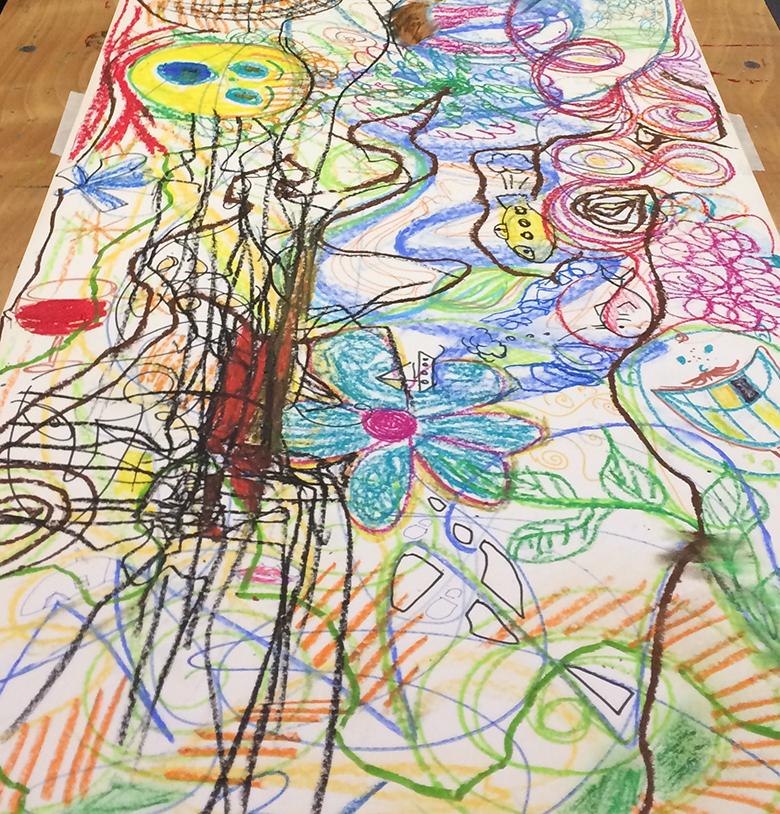
  • Disco doodling – Yep, dancing and drawing to music works for kids and adults alike, it’s a great way to warm up and break the ice. Plus, if you do it collaboratively, as we did, you get to scribble on other people’s work – what’s not to like!?
  • Play in your sketchbook – Kim’s handmade sketchbooks may have looked too good to ever make a mark in, but we encouraged participants to get over blank page block and just start sticking stuff (in this case, a small piece of the giant disco doodle) in. It’s all about progress NOT perfection!
  • One minute sketches – Grab a magazine, open anywhere and draw what catches your eye. We did this ten times. For one minute. Cue a kind drawing frenzy. But, if you get over yourself and go with the flow you can make some beautiful lines and come away with some creative jumping off points…
  • Miniature collages -A random word is used as the catalyst for a quick (20 minutes) playing card-sized collage. Remember: Boundaries can be everything!
Kim’s handmade sketchbooks in progress

These are a few photos from the evening:

Collaborative doodling to music
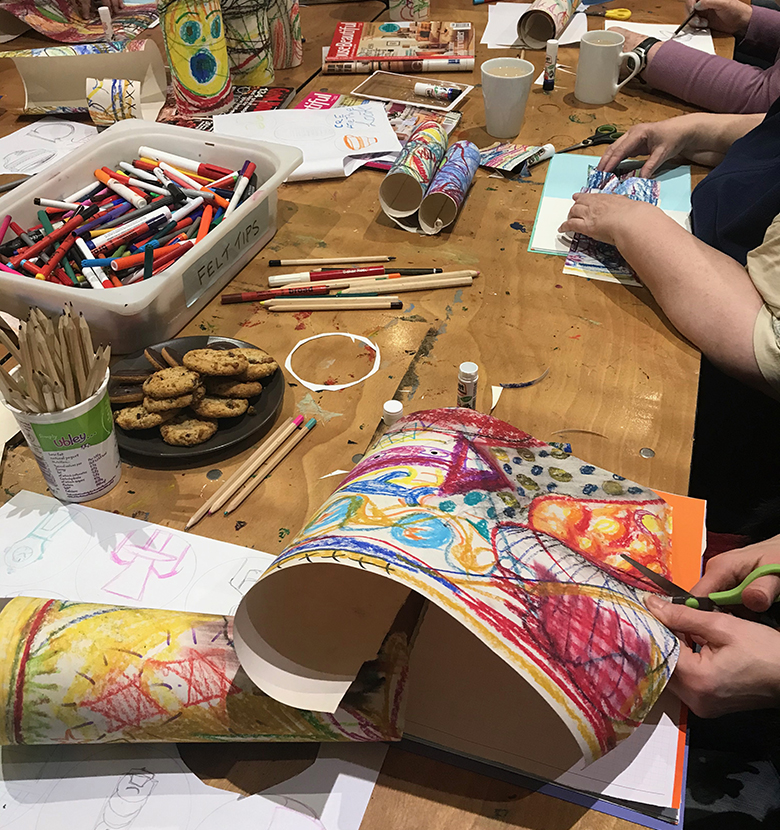
Cutting and sticking (with biscuits of course)
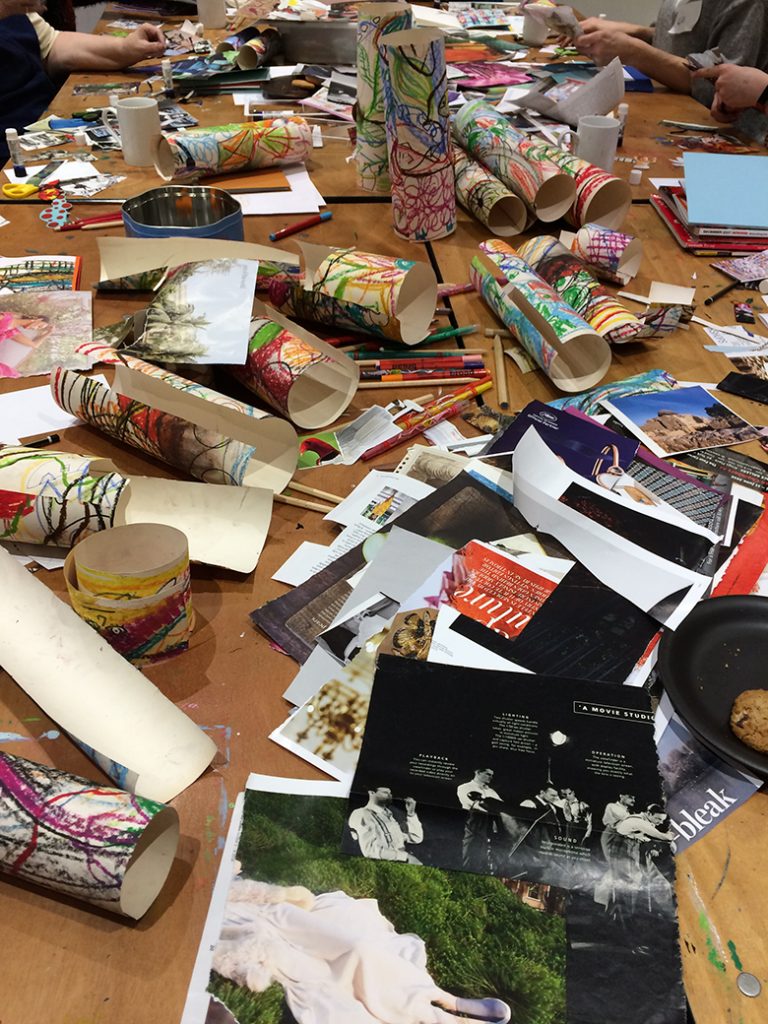
Everyone getting stuck in with collage

Summary

The moral of this workshop story? Well, it was just a real pleasure to watch people relax, have fun, and become immersed in their creations. Coming together to create is, as SEVEN knows only too well, a powerful thing. Not only does the room take on a kind of artistic buzz as people beaver away, but when we share the results it helps to inspire and motivate others too.

Remember: If you’re feeling the creative urge but don’t know where to start, just do it! Dance, doodle, sketch really fast, anything which helps you take the first step. Then keep going. Check out our SEVEN manifesto for inspiration.

New Leigh Art Trail Venue, New SEVEN Approach

Yep, Leigh Art Trail 2020 is on the way and changes are afoot. No, we haven’t forgotten about the fallout following year’s drastic measures, but a new venue does call for a slightly new approach.

Here’s what SEVEN have got in mind for LAT 2020:

  • Our new venue, The Refill Room, is Leigh-on-Sea’s first zero waste store – so we wanted to honour this ethical and eco friendly ethos with our books
  • Our 2020 theme is Reclamation – a powerful word which has a plethora of meanings. According to etymonline.com:

Reclamation (n.) late 15c., “a revoking” (of a grant, etc.), from Old French réclamacion and directly from Latin reclamationem (nominative reclamatio) “a cry of ‘no,’ a shout of disapproval,” noun of action from past participle stem of reclamare “cry out against, protest” (see reclaim). From 1630s as “action of calling (someone) back” (from iniquity, etc.); meaning “action of claiming something taken awat” is from 1787. Of land from 1848.

  • We’re using altered books instead of ready-made sketchbooks or hand-making our own – phew!
  • Workshops have been reinstated – we’re each taking it in turns to share a creative process
  • Our goody bags are back – we loved the idea of using similar items across our books, it’s a great way to see how five people use the same materials very differently…

Summary

Watch this space to see how our 2020 altered books develop. The first step is to find just the right altered book to work in – it can be easier said than done. For tips on picking and creating your own altered book check out this earlier SEVEN blog post “The Library of Reclaimed Books – a collaborative project.”