Leigh Art Trail 2026: SEVEN takes a literary theme

2026 is the National Year of Reading, and to celebrate, SEVEN has taken a literary theme for this year’s Leigh Art Trail.

Each artist chose a fictional book that resonates with them personally. Rather than thinking about how the books might inspire our artwork, we reflected on how they made us feel – the memories, emotions, connections and thoughts they stirred up, and why these particular stories have stayed with us.

Amanda Jackson

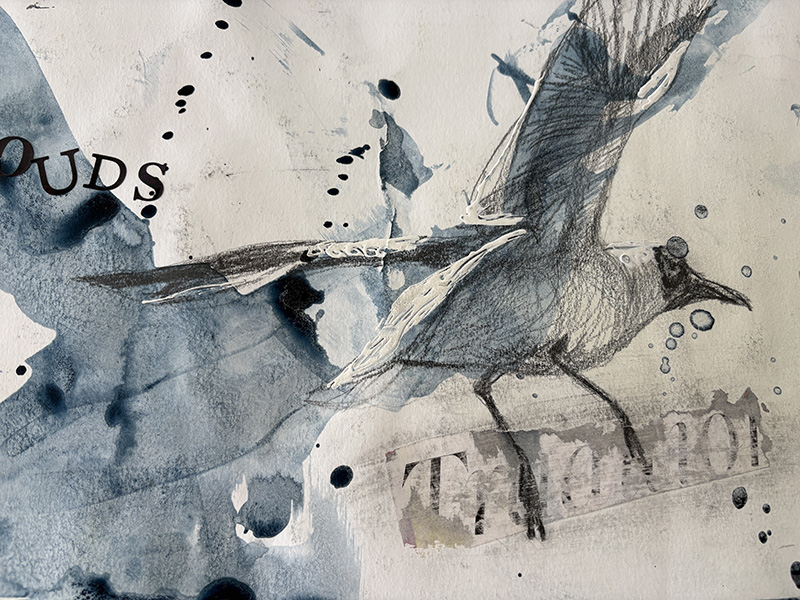
Jonathan Livingston Seagull by Richard Bach

Are you an avid reader, did you learn to love books as a child? I certainly did and was encouraged by my family from an early age.

One small blue book, a gift from my beloved aunt had a lasting impact on me and was the natural choice for this year’s theme, ‘to respond to a cherished book’.

I first read Jonathan’s story when I was about nine years old. It is a small novella, a little book and so was very appealing to a child, I loved the dark blue cover, the design and the blurred stylish seagull on the cover. Inside were intriguing photos of seagulls soaring and the simple prose took me away into the clouds. Initially it reads like a children’s story with lots of description of flying; I would later learn that Richard Bach was a pilot. I remember that suddenly there was an awful lot more to this story. Jonathan was no longer with us but in another place, he had died and gone to heaven. I can’t quite place the sensations that I felt, but I was moved spiritually.

I reread this little book many times, because it eventually fell apart and I bought another copy. As a young adult the book gives you much more. You are aware that there are themes around human nature, how we can be unkind to one another, particularly as children, how we should learn to love and forgive. That self-belief and individuality are worth fighting for. That we should not be afraid to go against the strong urge to conform, easier said than done.

Reading as an adult, you feel the undertone of issues around organised religion, this need within us to have something bigger than us that we should be worshipping, rather learning the lessons of history or doing the right thing. A fourth section was added to the book to celebrate its 40th Anniversary, which gave a more complete finish to it, although I don’t think it needed it.

So that’s the story and its impact, now how to respond!

As this story hit me in waves over the decades that I have read it, giving me something new each time, my artist book is a concertina book, that has no structure, no narrative form of beginning, middle and end, but hits you from all directions and revolves and moves, like flight. It can begin or end at any point. I invite you to suspend judgement and just enjoy each page for its own sake which is pretty much how I made it.
Amanda’s book

Juliet Bryson

Swallows and Amazons by Arthur Ransome

As an avid reader from childhood, it was a difficult choice, but I decided on Swallows & Amazons series by Arthur Ransome.

This book (and the subsequent 11 in the series) brings back memories of family and Girl Guiding camping trips.  My memory is that we had one book between us each holiday (and would then take it turns to read)

I think what was appealing is that (as in many children’s books) the children go off to have an adventure without adults around and have to learn to cope making their own decisions, navigating new friendships and unfamiliar surroundings.

The children have different personalities – John the oldest, being the responsible one, tasked with making sure the others don’t drown, Susan the homemaker, Roger the youngest with no sense of responsibility and taking each moment as it comes.  Titty is the dreamer, who sees the world through the books she reads.

Even though the book is written in the 1930s, there is already a sense of nostalgia for a Lake District way of life that is changing, and of complaints about the “Day Trippers” and “Hooligans” that are encroaching on the peace and quiet of the area.

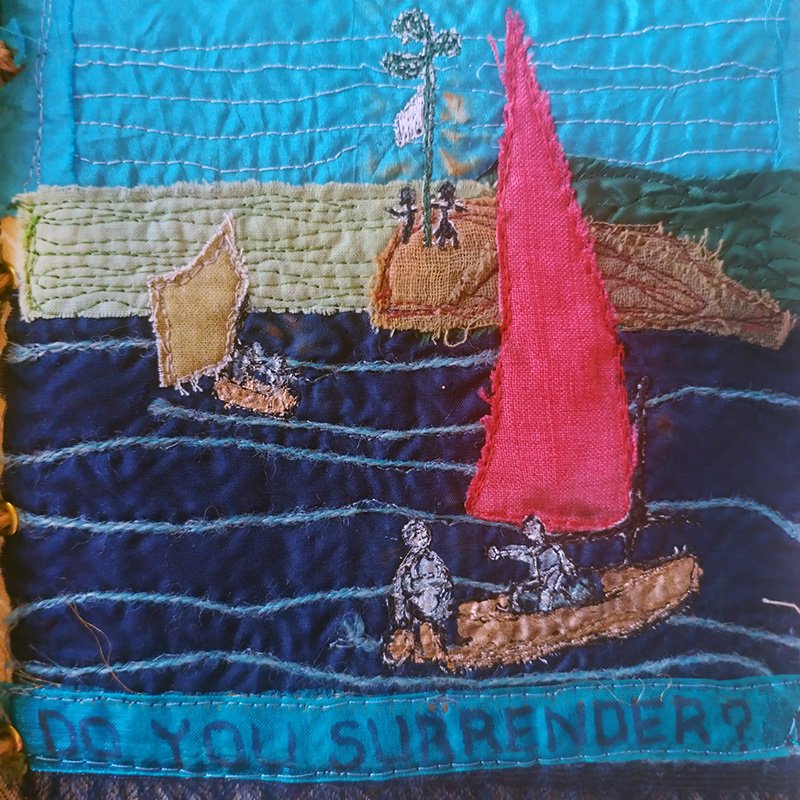
My artist book is made of canvas to tie in with the material their tents and boat sails would have been made from, and the concept of ’making do’ and that scraps of fabric would have been kept and reused.

The illustrations are by Ransome himself, who apparently wasn’t happy with his proposed illustrator’s images. I like their black and white simplicity which means they have a timeless quality. I have used Gelli-printing, transfer printing, stamps, felt pens, and free machine embroidery to re-interpret them.
Juliet’s book

Nicola Watts

Do Androids Dream of Electric Sheep by Philip K. Dick

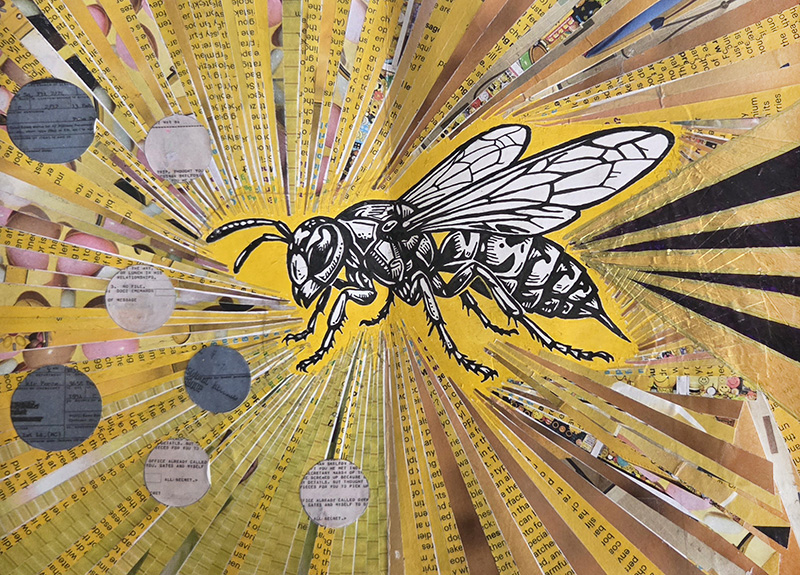
I based my project on the book Do Androids Dream of Electric Sheep by Philip K. Dick and both Bladerunner films. I came across the original film first – wrong way round I know – when I was 16 and had just started college. I read the book not long after and it’s important to me as I was captivated by this alternative reality just as I was discovering who I was and what I enjoyed in the world (and what I definitely didn’t). I read many other books at that time as part of my studies and beyond, but this one has remained a firm favourite.

Whenever I read it again or re-watch the original film – I enjoy the sequel too, but obviously that’s far more recent – it takes me back to the times when life was becoming a real adventure with so many possibilities at my feet. That was all a pretty long time ago now. The world has changed and continues to change, as do I, but the themes of empathy, authenticity and emotion remain more important than ever in the climate of uncertainty that we live in. I still love an adventure though!

I deliberately chose not to reveal the book and films when showing my project at the Leigh Art Trail. I’d wanted our visitors to travel through my work and see if they could guess what it was about from the clues, I left scattered along the way. It was delightful watching people engage with my work and even more so when they got it. And, for those who didn’t know the story, it was still an exciting ride through my interpretations.
Nicola’s book

Jo Bund

Alice’s Adventures in Wonderland by Lewis Carroll

My artist book is inspired by Alice’s Adventures in Wonderland, exploring one of the story’s recurring themes of growth and identity through the question: “Who am I? Who are you?”

Inspiration

I was given this book as a child and was captivated by John Tenniel’s detailed black-and-white woodcut illustrations. I was fascinated by the unforgettable characters – particularly the Cheshire Cat, the White Rabbit and the Caterpillar – as well as the surreal journey through Wonderland. Alice’s changing size, her fall down the rabbit hole, and the symbolic door and key all represent transformation, curiosity and hidden possibilities.

The structure of my handmade artist book echoes these ideas. When opened, it unfolds like a tumbling cascade of playing cards; when closed, it concertinas into the shape of a pack of cards. I have used collage, mixed media, garden foliage and Shisha embroidery mirrors to create layered surfaces that invite closer exploration.

Aim

Many phrases from Alice’s Adventures in Wonderland have become part of everyday language: “Down the rabbit hole,” “I’m late,” and “Who are you?”

As I enter a new chapter of life, I have found myself returning to that last question. My age, career and the growing influence of AI have prompted me to reflect on my own identity and direction. Creating this artist book has given me the opportunity to explore those questions and consider where I want the next chapter to lead.
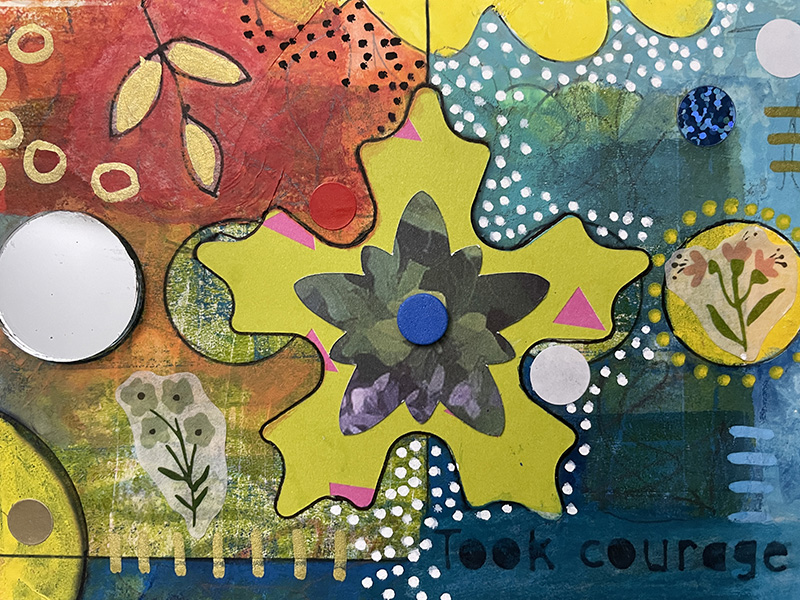
Jo’s book

Helen Davis

The Little Black Book of Short Stories by AS Byatt

This year’s mixed media project has been inspired by The Little Black Book of Stories by A.S. Byatt, a collection of five short stories often described as a cabinet of curiosities—filled with images and ideas that are at once beautiful and grotesque, mundane yet magical.

Each story explores a different aspect of the human experience:
The Thing in the Forest explores childhood trauma, memory, and fear through the experiences of two wartime evacuees who encounter a mysterious creature in the woods.

Body Art centres on the female body, medicine, and birth, culminating in an artwork inspired by the Hindu goddess Kali, a powerful symbol of creation, destruction, and transformation.

A Stone Woman follows a woman’s physical and psychological metamorphosis after the death of her mother and her own illness, as she gradually transforms into stone.
Raw Material reflects on storytelling, creativity, and the hidden darkness of domestic life through an elderly woman’s memories of housework as relentless labour.
The Pink Ribbon considers ageing, memory, dementia, love, and loss through the relationship between an elderly couple and the haunting presence of the woman’s younger self.

Together, these stories weave through themes of trauma, the female body, metamorphosis, memory, and mortality, providing a rich starting point for my own visual responses.

Combining a range of materials with my life drawing studies and found imagery, each piece explores the layered symbolism that characterises Byatt’s writing.

Personal objects are also woven into the work, creating connections between fiction and lived experience. For example, the small red book used in my response to The Thing in the Forest belonged to my Nan, who, like the story’s protagonists, was a wartime evacuee.
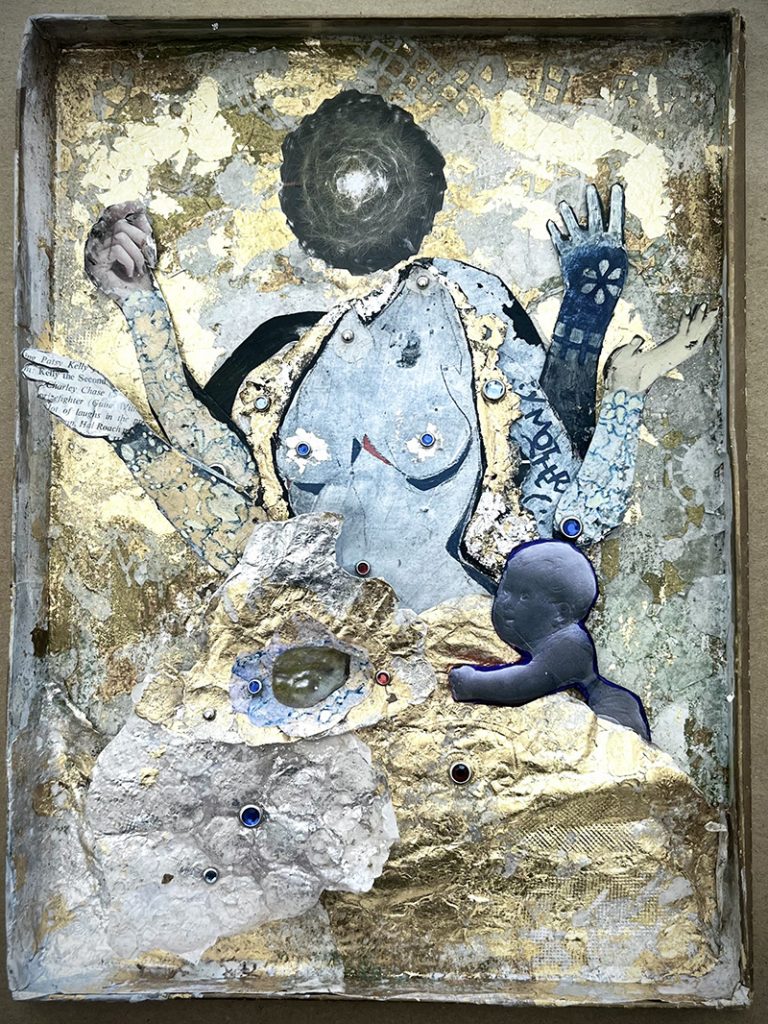
Helen’s book

Kim Saunders

Wide Sargasso Sea by Jean Rhys

REBELLION!

I always loathed Jane Eyre – yes, I confess. I thought the book was tedious and the heroine was a sanctimonious, judgemental bore. There I have said it.

I was always a bit rebellious in my English Literature classes (sorry Mr Reynolds), and don’t even get me started on The Pilgrims Progress! This year for the Leigh Art Trail, and 2026 being The Year of Reading, when we chose “Literary” as our theme and I needed to select a book, my thoughts immediately turned to Wide Sargasso Sea by Jean Rhys.

We all wanted to choose a book that had meaning to us, or had made a difference to us, and this book changed how I viewed things, and taught me to think and question the narrative.

So, back to Jane Eyre. I realised that nearly everyone but me loved it, but it took reading Wide Sargasso Sea to make me think about why I did not. I became aware that I was not alone in questioning the whole ‘mad woman in the attic’ situation. If a wife became inconvenient, it seems it was not uncommon to declare her “mad” and lock her away. When you look at the timeline it’s even worse, she was imprisoned for a decade.

Locked away for ten years, if you weren’t mad to start with, you would have been positively furious by the end – no wonder she burnt the house down!

Rochester becomes not in the least bit romantic. He tries bigamy, and when that doesn’t work, he suggests Jane becomes his Mistress. How charming.

I’m afraid that “Reader, I married him” was not the ending I sought.

In this book, I try to give a feeling of Wide Sargasso Sea, and I hope you enjoy my impressions enough to seek out a copy and read the book, so you can draw your own conclusions.
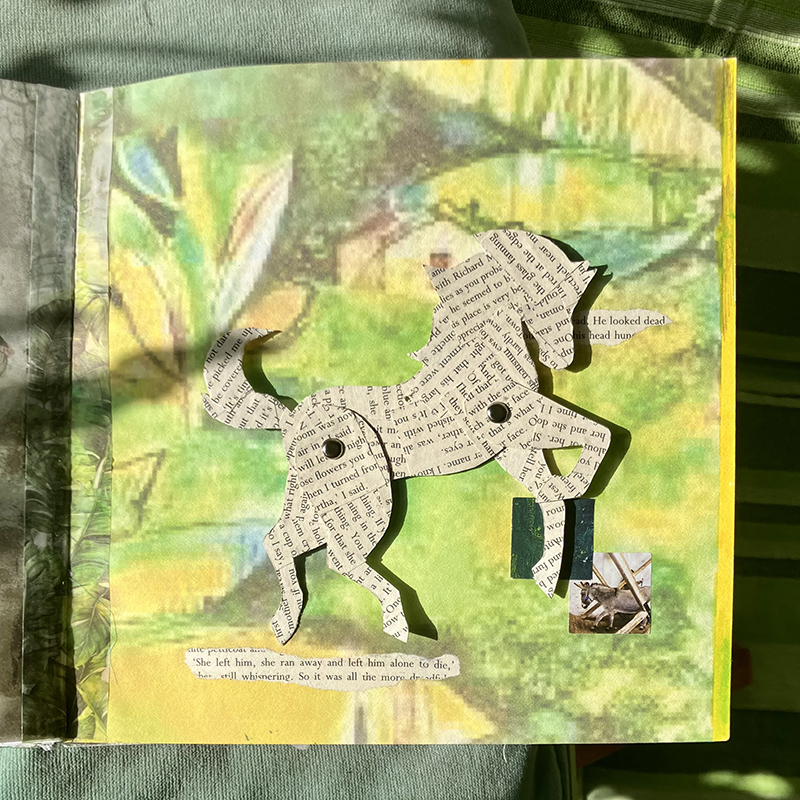
Kim’s book

The Leigh Art Trail runs from Saturday 4th July to Sunday 19th July.

SEVEN Artists Reimagine Childhood for Leigh Art Trail 2025 

This year, the SEVEN artists’ book collective are diving headfirst into the wild, wonderful world of childhood for Leigh Art Trail 2025. 

Our latest project is playful, nostalgic, and deeply personal — each artist is transforming reclaimed children’s books into one-of-a-kind altered books that celebrate and explore the many layers of being young.

By repurposing old storybooks, SEVEN are breathing new life into forgotten pages. These altered books become part memory, part dreamscape—each one a unique visual narrative crafted through a joyful mix of materials and methods. 

The creative process has been as diverse as the artists themselves. Expect to see everything from bubble printing and ink experiments to bold sticker play and whimsical collage.

Playing with spirographs

While some SEVEN members have delved into personal photo archives — using family pictures and fragments of childhood memories as a jumping-off point — others have leaned into the surreal, dreamlike quality of those early years.

What unites all the work is a sense of play—both in process and in spirit. Whether recalling real-life moments or conjuring imaginary adventures, each book invites viewers to reconnect with their own sense of wonder and curiosity. 

SEVEN will be exhibiting our curious collection of handmade art books at Leigh Road Baptist Church during Leigh Art Trail 2025. It’s the perfect setting for a show that invites reflection, imagination, and a touch of childhood mischief. 

Come turn the pages, and remember what it felt like to be small.

Leigh Art Trail Venue 41: Leigh Road Baptist Church

Without Boundaries: Estuary Festival Anthology programme

Three of the members of SEVEN, Amanda, Kim and Juliet, are delighted to be part of the “Without Boundaries” exhibition to be hosted at Hadleigh Old Fire Station in June 2025.

This is an exhibition of contemporary mixed media art, with evocative and strong links to themes ofmemory, nature, and the Estuary, exploring both the fragility and depth of the Estuary’s ecosystem.

The artists featured will be working in a variety of media, including textiles, collage, 3D, sound, video, light, ceramics, mosiacs and sounds.

Its on Saturday 21 and Sunday 22 June, 10am to 4pm, free entry and free car parking. You also invited to the Private View on Friday 20th, from 6-9pm. 

This forms part of the Estuary Anthology, a showcase of independently produced creative activities taking part during the 2025 Estuary Festival – check out estuaryfestival.com for all the details.

Without Boundaries poster

100 Beautiful Postcards, 1 Great Cause – Made in Essex Raises £4000 for Dementia Support

In February 2025, the Made in Essex Secret Postcard Sale made a triumphant return—and with it, a powerful reminder of how creativity and community can come together for a greater good.

Hosted at 70 The Broadway, the event showcased 100 beautiful postcards created by a wide range of local talent. Among them were mini masterpieces from SEVEN members, each contributing their unique style and voice to the vibrant exhibition. But there was a twist: each postcard was exhibited anonymously, and the identity of the artist remained a mystery until after purchase.

SEVEN’s postcards (Photo by Becky Noelle)

Art lovers from across Essex eagerly snapped up Golden Tickets for their chance to own one of these tiny works of art. Each ticket guaranteed the buyer a postcard—but not the choice of which one. The random element added a spark of excitement to the sale, with buyers walking away with a surprise piece from a mystery artist.

Every penny raised—£4000 in total—went directly to Metal’s NetPark Wellbeing Project, which delivers transformative art classes for people living with dementia. This innovative programme uses creativity to spark joy, encourage connection, and bring a sense of peace to both participants and their carers.

Project Manager Emma Mills expressed heartfelt gratitude:

“I cannot thank you enough. I see firsthand the joy, fun and sense of peace these sessions bring to carers and participants…”

This event was more than an art sale—it was a testament to the power of community, compassion, and creativity. By turning postcards into purpose, Made in Essex and its generous supporters made a meaningful difference in the lives of those navigating dementia.

100 postcards. 1 great cause. Countless moments of joy.

Some of the 100 postcards on display

Clifftown Telephone Museum exhibition

Our theme for this year’s Leigh Art Trail was Ghosts which we exhibited at Metal Southend. When we were invited to exhibit in the Clifftown Telephone Museum during October, the month of Halloween, the theme of our books was the natural choice.

We have taken images from our books and reimagined them into a new form. The paper dress was inspired by the Regency style of Princess Caroline, wife of the Prince Regent, who stayed in the now renamed Royal Terrace in the early 1800s.

Each artist took inspiration for their ghost-themed book from a wide variety of subject matter. Read on to find out more…

Nicola Watts – Ghosts

The topic of ghosts has been very inspiring for my love of working with colour, texture, found images from old books, newspapers and magazines, and shots I’ve taken on my travels.

It’s also been a chance to explore the idea of what a ghost is. Are ghosts really lost souls, wandering?   Sometimes with good intentions?  Playful, even? At other times angry with the life and people they left behind?

I wondered if buildings or the natural environment can gather energies and emotions and store them like a recording to be played over and over again, creating the perception of a presence that we can hunt down?

Even where there are rational explanations for ghosts – sleep paralysis, a mouldy room, electromagnetic fields or infrasound – experiences are still undeniably profound, creating a story to be told. 

Nicola Watts – artist book page

Jo Bund – Ghostly prints

This quote came from the book Miss Willmott’s Ghosts which initially inspired me…

“The book recalls a world that no longer exists, populated entirely by shadows. A grainy, black and white world in which even major players have become phantoms, sometimes without even a monochrome snapshot to their once famous names.”

Sandra Lawrence (2022)

Miss Willmott loved to take photographs. These now give us a glimpse into her life at Warley Place, where she lived from 1875 until her death in 1934.

Photography began around the 1840s, and during the mid-19th century the Spiritualism movement contributed to the Victorian’s fascination with spirit photography (or ghost photography). 

The aim was to capture an impression of someone in the afterlife. Yet, the most likely causes of such ghostly images would likely have been scratches, dust, lens flares, double exposure, and so on, that occurred during the photography process.  

Taking inspiration from Miss Willmott’s Ghost, Warley Place, and ghost photography I have created my own ethereal images. Collaging layers of black and white photographs, mono prints, drawings, text and stitch. The resulting artist’s book is composed of seven signatures, bound together with a concertina spine.  

Jo Bund – artist book page

Juliet Bryson – Ghosts of Chalkwell Hall

When I found out that Chalkwell Hall was to be our venue for this year’s Art Trail, it seemed an obvious idea to investigate whether there were any ghosts associated with the building.

Using research by writer, artist, and archivist Rachel Lichtenstein* as a starting point, I delved into the history of the Hall.

Chalkwell Hall seems to be unusual.  It has been inhabited by a number of different owners and occupiers, as opposed to the “one family” history we often associate with “big houses”.

So my book dips into the lives of the people who are recorded as having once lived or worked in the Hall, as they “talk” to us from the past. 

*Rachel’s research is available to download from the Metal Website.

Juliet Bryson – artist book page

Amanda Jackson – Ghosts

I must confess that this year’s artist’s book has grown in an instinctual way. No one idea has dominated the process of creation, but I have allowed it to develop and suggest to me what my overarching concerns were with the theme ‘Ghosts’.

My first thought was related to the idea of sound waves ‘infrasound’ or the ghost frequency as it has been called — a high-pitched frequency that the human ear does not hear but perceives through a sense of unease, skin pricking, or feeling a cold presence.

How to approach sound in a flat two-dimensional book? Rhythm and repetition seemed to work, something that SEVEN often incorporate in our work. 

My second approach was to consider the gothic ghost stories, apparitions in grey, men and women such as ‘The Woman in Black’.  Found images often lead the way here and some high gloss fashion shoots stand in for my women in grey and black.

Weaving the workshop produced artwork and the shared art materials we must include, allowed these impressions to build and grow. The result is a book that is a little weird — but then isn’t the idea of ghosts a little out there?!

Amanda Jackson – artist book page

Kim Saunders – A Miscellany of Ghosts

The title “GHOSTS” was suggested by a previous member of the SEVEN Collective. But where to begin with such a prompt?

Well, I began with a list.  Thinking about ghosts I wrote down whatever sprang to mind. As the list grew and grew, I realised that we use the word ‘ghost’ to describe a great many diverse things.

My enjoyment of researching subjects of interest to me has led me to integrate this into my art practice, which also often features graphic collaged elements and words.

And that, in short, is how I came to the idea of making my Miscellany of Ghosts.

Kim Saunders – artist book page

Helen Davis – Hauntings

Are you haunted? Some years ago I was reflecting on some deeply embedded beliefs. Beliefs that were holding me back. Where had they come from? A bit of digging and there it was, a clue — the death of my maternal grandmother.

She’d died when I was five. Obviously I hardly knew her. But then, neither had anyone really — apart from her beloved husband, my grandad Last, that is. He idolised her. Wrote poetry to her. Pined for her until the day he died, laying out her nightdress in preparation for some immortal reunion.

In contrast, the woman my mother and her eleven siblings experienced was earthy. Swearing in spoonerisms. A fan of horror legend Boris Karloff. Superstitious — especially about Tutankhamun. Always in the kitchen, a cigarette hanging off her lip.  Turned out she was a touch more mysterious, of course.

And, so my book endeavours to honour my grandmother. Piecing together: my own fragmentary impressions; memories and anecdotes told by others; found items; and words. Words written by my grandfather. Even words recorded by mediums consulted following her death.

Yet, ultimately, I think this book is about haunting. How we’re haunted by our pasts. Our choices. Our guilt. Our memories. Haunted by our ancestors, even…

Helen Davis – artist book page

Further information

The exhibition will be on from 21 October until 22 November 2024. The Clifftown Telephone Museum is based at Capel Terrace, Southend-on-Sea SS1 1EX